Who are we?
Fuels Industry UK (FIUK) is a trade association whose members refine and supply over 85% of the UK’s transport fuel and are essential to delivering both today’s energy security and tomorrow’s transition to low-carbon fuels.
Our members own and operate the UK’s surviving refineries and fuel supply infrastructure including terminals, pipelines and petrol filing stations. They employ thousands directly and supporting hundreds of thousands more in the wider supply chain across the UK. We work with government, regulators and across sectors because the UK fuels sector must remain competitive and resilient to be able to invest in the technologies needed for net zero.
Key Information:
Name: Fuels Industry UK Ltd (formerly UK Petroleum Industry Association)
Founded: 1979
Chief Executive Officer: Elizabeth de Jong
Fuels Industry UK Member companies:
| Members | Associate Members | |
| bp | Coryton | |
| EET Fuels | DragonLNG | |
| ExxonMobil | Exolum | |
| Phillips 66 | Southern Energy | |
| Shell | NationalGrid | |
| Valero | British Pipeline Agency | |
| LanzaJet | ||
| Petroineos | ||
| Natural State Renewables | ||
Member companies operate: refineries, fuel terminals, Liquefied Natural Gas (LNG) terminals pipelines, petrol filing stations, low carbon fuels manufacture and supply sites (including Sustainable Aviation Fuels, biofuels and others)
UK Fuels Sector – facts at a glance (2024 figures unless stated)
- 4 operating refineries left in the UK following 2 closures in 2025 (down from 9 in 2000 and 19 in the 1970s).
- Supplies 47% of UK final energy consumption.
- 100% of aviation, 97% of road and 58% rail still relies on liquid fuels.
- Supports 100,000+ jobs across the UK (4,000 directly in refineries).
- Collects £37 billion annually in tax revenues (duty + VAT).
- Among the lowest-carbon refineries globally: 80% of UK’s top 10 import partners in 2022 had higher carbon intensity.
- Already delivering lower-carbon fuels equivalent to removing 3 million cars from the road each year.
UK refining capacity and petroleum products demand
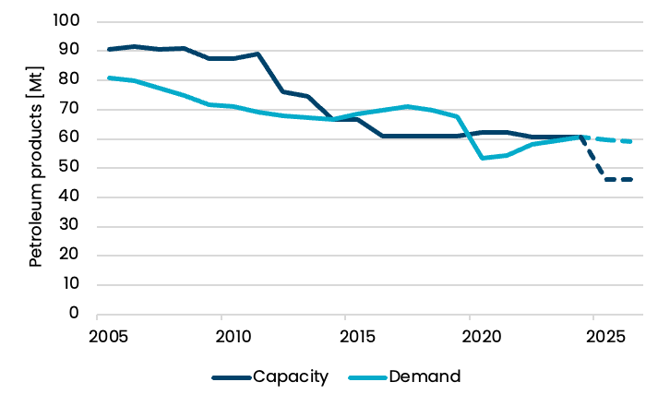
Historic domestic refining capacity exceeded the UK demand, with imports and exports used to balance the specific fuel demands. With demand decreasing but still predicted to remain the domestic capacity is set to remain below the demand. This increases the reliance on imports and further compromises energy resilience.
UK imports and exports of petroleum products
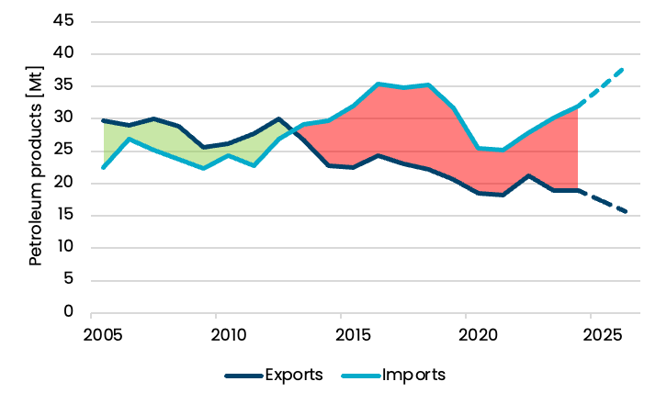
Prior to 2012, the UK was a net exporter of petroleum products but with decreasing refining capacity and a persistent demand the UK is increasingly becoming a net importer with the gap set to grow to over 20 million tonnes, about a third of UK demand.
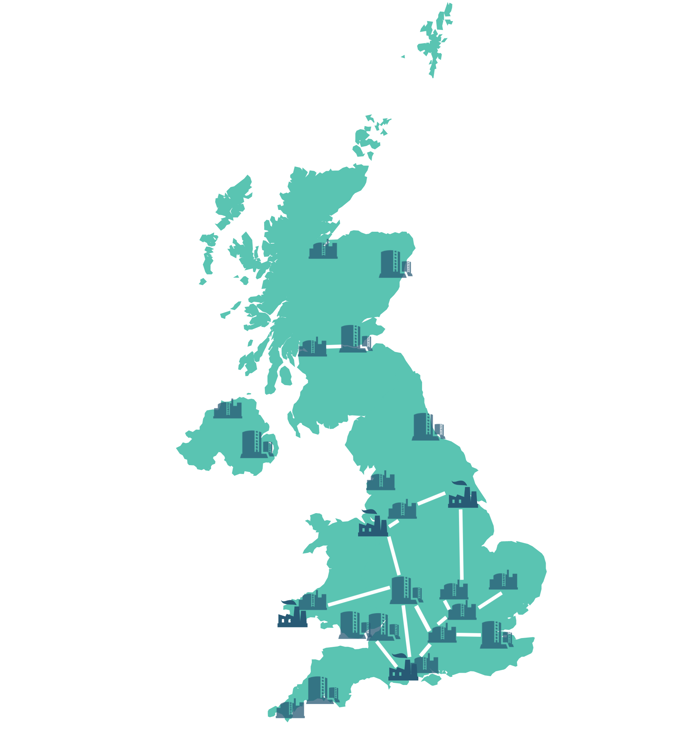

This map is indicative of the major supply points across the UK and the interconnectedness of major refining and terminals to inland distribution sites via dedicated oil pipelines. In total, there are now 4 operational refineries, 60 terminals used for fuel supply and over 3,000 miles of pipelines.
Our statistics publication with the latest data on the fuels sector for 2025 can be found here.
Resources
Find our latest press releases and statements here.
Find our position papers summarising our top policy priorities on carbon border adjustment mechanism, lower carbon fuels and carbon leakage here.
Find our statistics publication with the latest data on the fuels sector for 2025 here.
Find information about how the downstream fuels sector in the UK works here.
Find information on health and safety around fuel forecourts here.
Contacts
Jamie Baker, Jamie.Baker@fuelsindustryuk.org
Tel: +44 (0)20 7269 7605 | Mobile: +44 (0)7468 694 731
If Jamie is unavailable, please try alana.hepburn@fuelsindustryuk.org, or bruce.rothberg@fuelsindustryuk.org
Supplied images